I've been lifting for about two years now. When I started, the gym felt like a hundred machines and a thousand YouTube opinions. What finally made it click was a simple realization : you're not training exercises, you're training muscles. Once you know what a muscle looks like, which parts it has, and which movement hits which part, the whole gym collapses into a short, boring, effective list.
This post is that list. One section per muscle, a map of its parts, and the two or three exercises I'd actually pick for each part — with a recommendation when it matters.
The rules that matter more than any exercise
Before the map, five things that decide 90% of your results :
- Progressive overload. Every week, try to do slightly more than last week — one more rep, or a little more weight. This is the entire game. An exercise without progression is just movement.
- Form first, ego never. A controlled rep with full range of motion beats a heavy half-rep every time. Lower the weight slowly — the lowering (eccentric) part builds most of the muscle.
- More is not better — manage your volume. The beginner instinct is that more exercises, more sets, more reps = more muscle. It's the opposite : past a point, extra sets just pile up fatigue, your muscles don't recover by the next session, and you come back weaker instead of stronger. Two to three good sets per muscle region — taken close to failure, with real intensity — is enough. For chest, that might be 3 sets for upper, 3 for middle, 2 for lower, done. A few hard sets beat a dozen tired ones.
- Protein and sleep. Roughly 1.6–2g of protein per kg of bodyweight, and 7+ hours of sleep. Muscle is built in the kitchen and the bed, not the gym.
- Consistency beats optimization. Three average workouts a week for a year beats one perfect week a month. Pick simple exercises you'll actually repeat.
Now, the muscles.
Chest
The chest (pectoralis major) is one muscle, but its fibers run in three directions — so it has three trainable regions : upper, middle, and lower. The trick is simple : the angle you press at decides which region works hardest.
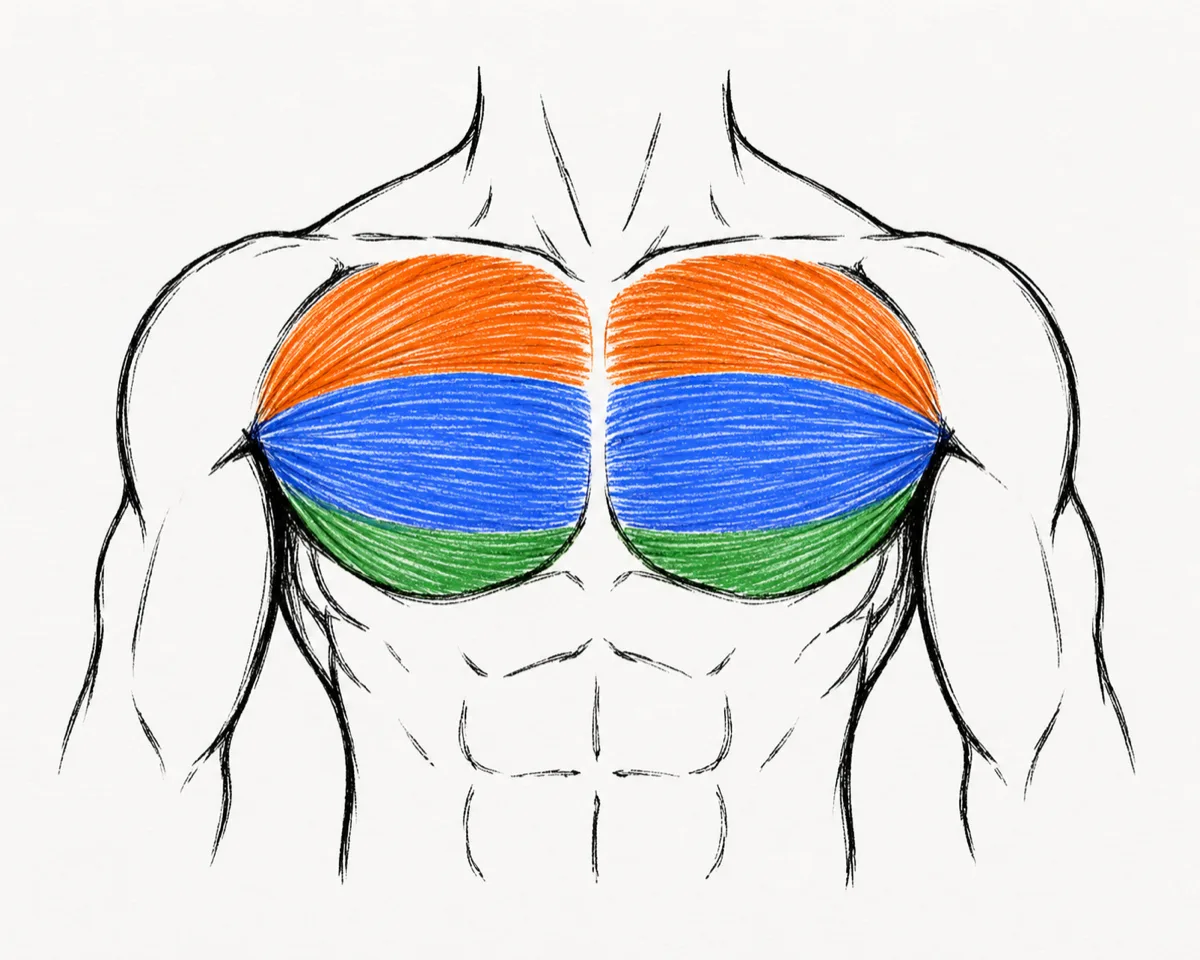 orange : upper · blue : middle · green : lower
- Upper chest — incline press (dumbbell or barbell, bench at ~30°). I prefer dumbbells : a deeper stretch and each side works honestly.
- Middle chest — flat press (barbell or dumbbell). This is your bread-and-butter heavy press.
- Lower chest — dips or high-to-low cable fly. A common mistake (I made it too) is using the pec-deck fly for lower chest — the pec deck mostly hits the middle. To bias the lower fibers, the movement has to travel downward : dips, or cables set high pressing down.
A fly (cable or pec deck) is still worth one slot in your week — it stretches and squeezes the chest in a way presses can't. Just know it's a middle-chest movement, not a lower-chest one.
Shoulders
The shoulder (deltoid) has three heads : front, side, and rear. Here's the beginner-friendly secret : the front delt barely needs its own exercise — every chest press and overhead press already hammers it. The side and rear delts are the neglected ones, and they're what make shoulders actually look wide and give them that rounded, 3D look.
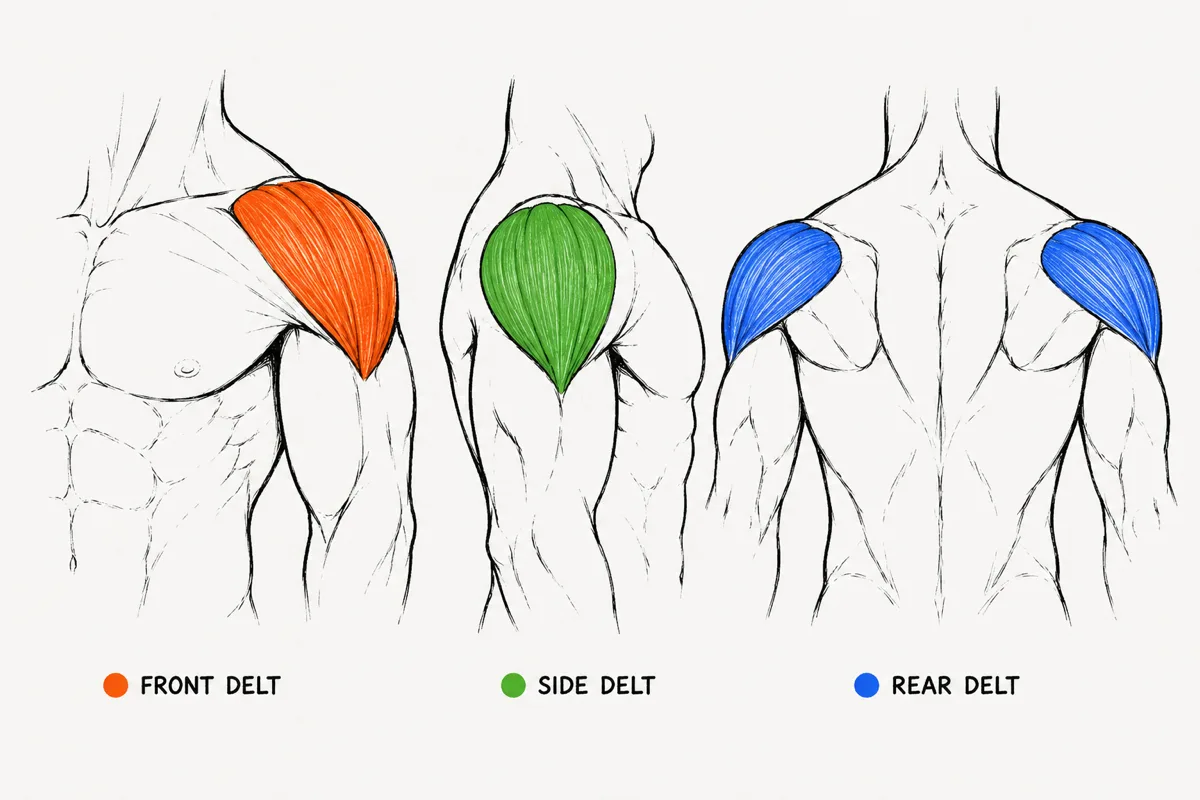
- Front delt — overhead press (military press or seated dumbbell press). One pressing movement is enough; your chest days are already paying rent here.
- Side delt — lateral raises. Dumbbell or cable — I recommend cable. With a dumbbell, the weight does almost nothing at the bottom of the rep; a cable pulls on the muscle through the entire arc. Constant tension, better stimulus, lighter weight needed.
- Rear delt — reverse pec-deck fly or face pulls. Face pulls also train the small muscles that keep your shoulders healthy, so they're my pick.
Triceps
The triceps is three-quarters of your arm size (the name literally means "three heads") : long, lateral, and medial. You only need to remember one distinction — the long head attaches above the shoulder, so it only gets fully stretched when your arms are overhead.
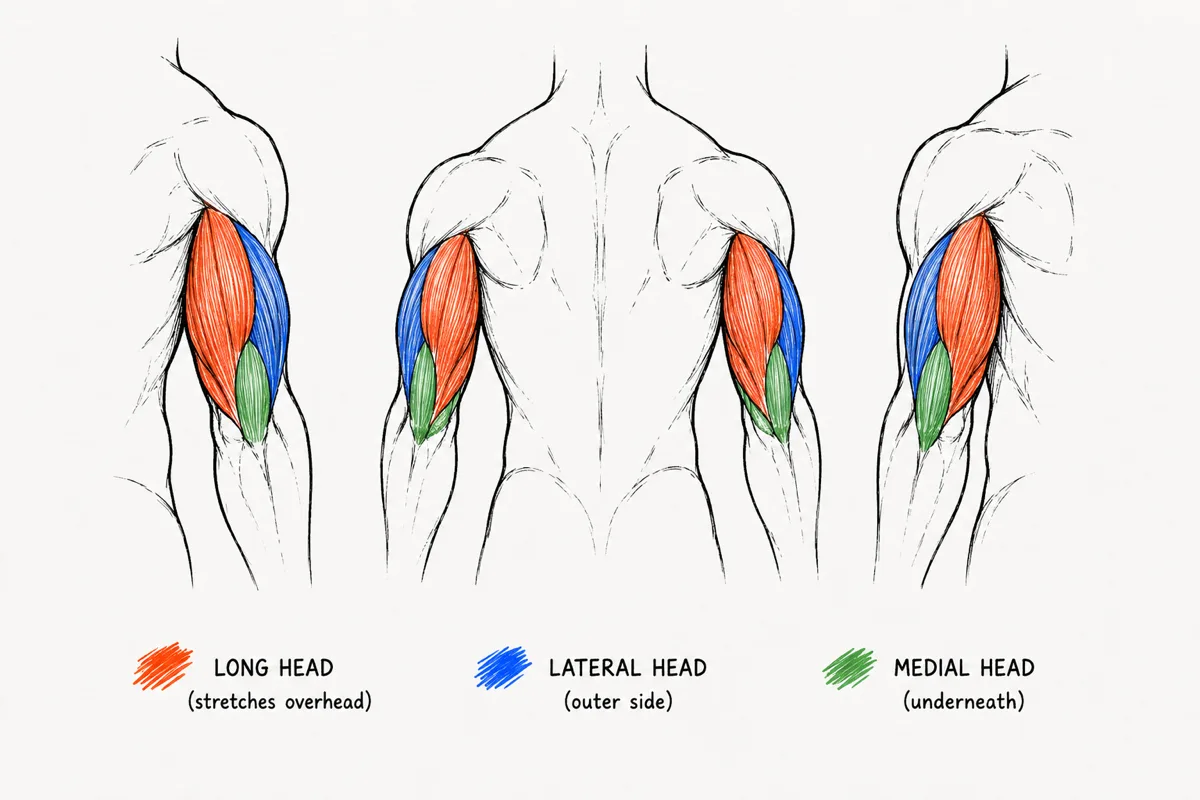
- Long head — overhead extensions (cable rope overhead, or a dumbbell behind the head). Arms up = long head stretched = growth.
- Lateral + medial heads — pushdowns (rope or straight bar on the cable stack). Arms at your side = these two do the work.
That's it — two exercises cover the whole muscle. One overhead, one pushdown. (I had this backwards for a long time, doing three pushdown variations and no overhead work. Don't be past-me.)
Back
The back is a team of muscles, but for training you only need two ideas : width and thickness.
- Width comes from the lats — the big fan-shaped muscles that give you the V-taper. Lats are built by vertical pulls : pulling from above your head down toward your body.
- Thickness comes from the mid-back — rhomboids, mid traps, rear delts. Built by horizontal pulls : rowing toward your torso.
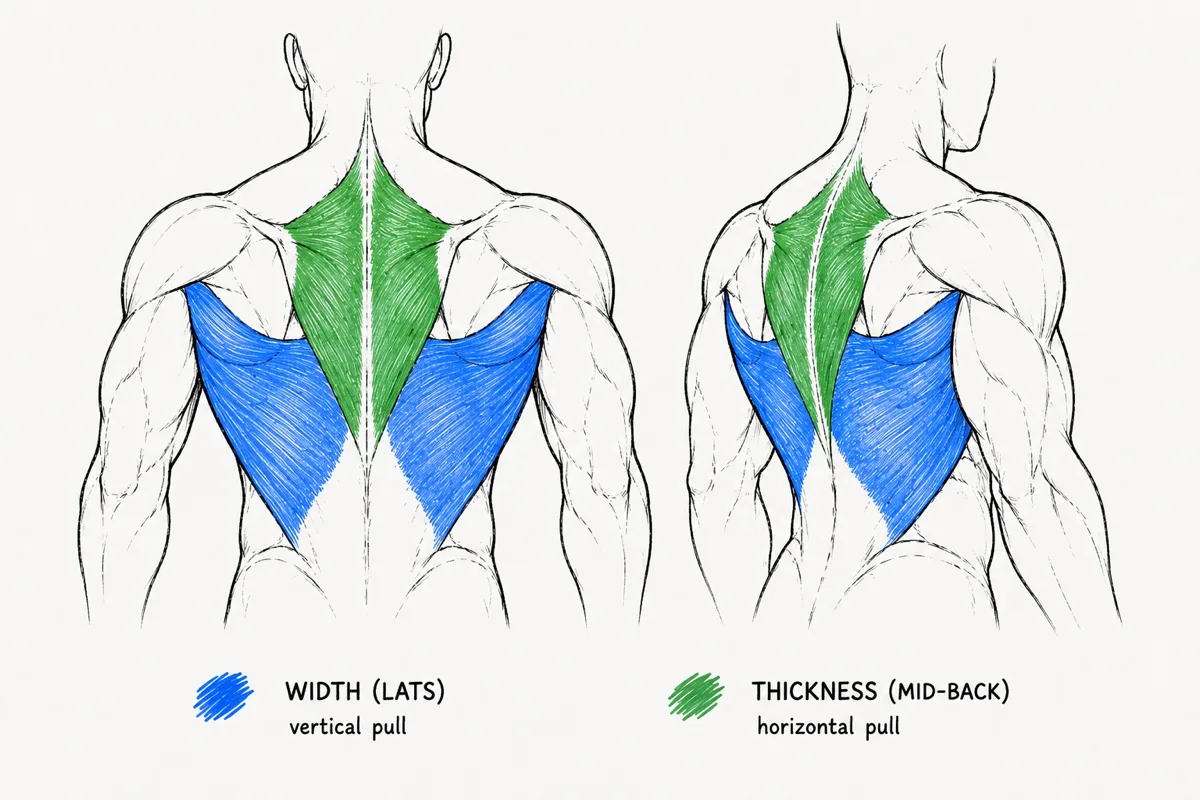
- Vertical pull — pull-ups or lat pulldown. Pull-ups if you can do them; pulldowns until you can.
- Horizontal pull — barbell row, seated cable row, or a chest-supported machine row. If your lower back tires before your lats do, pick the chest-supported one.
- Lower back — back extensions, or just deadlift variations if you do them. Keep it simple; the lower back gets plenty of indirect work.
One vertical + one horizontal per week is a complete back program for a beginner.
Traps
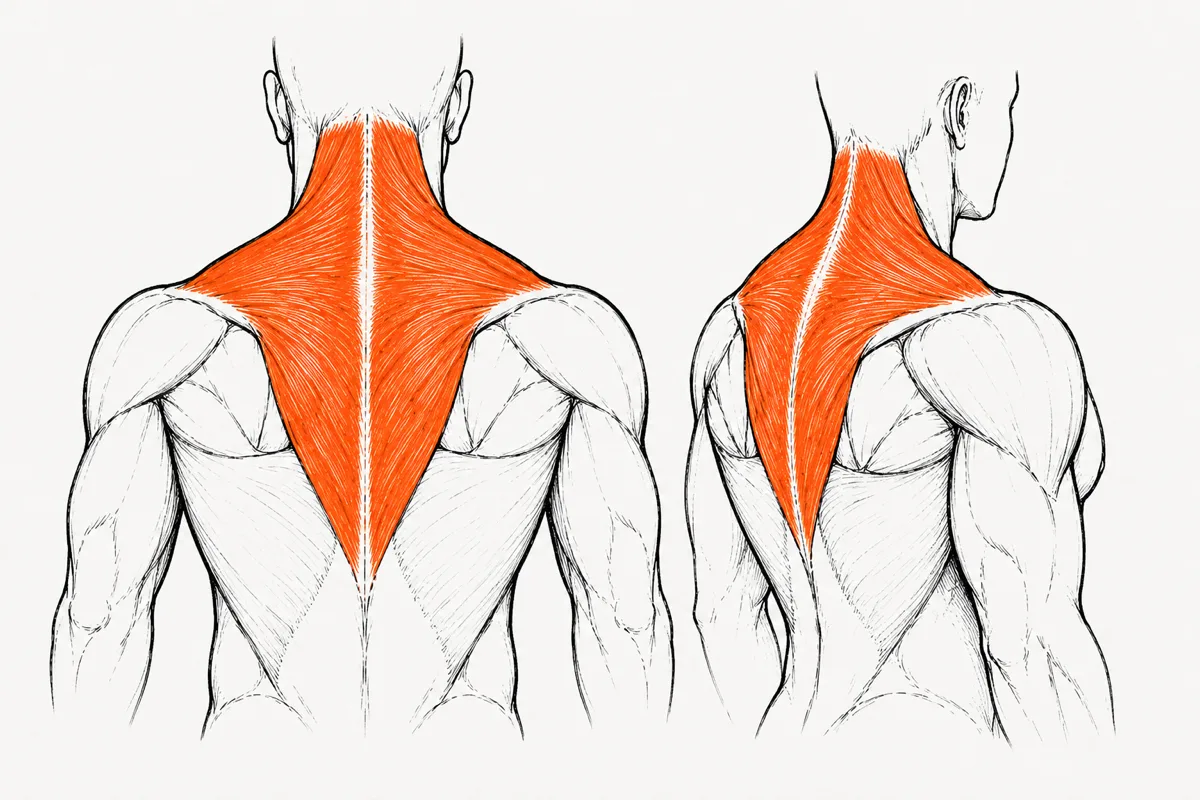
The traps run from your neck down to your mid-back. The upper traps (the part everyone means) respond to one thing : shrugs — dumbbell or barbell, your pick. Hold the top for a second instead of bouncing. The mid and lower traps are already covered by your rows and face pulls, so one shrug movement is genuinely all this section needs.
Biceps
The biceps has two heads — long (outer, makes the peak) and short (inner, makes the width) — plus a hidden helper underneath called the brachialis, which pushes the whole arm up and makes it look thicker.
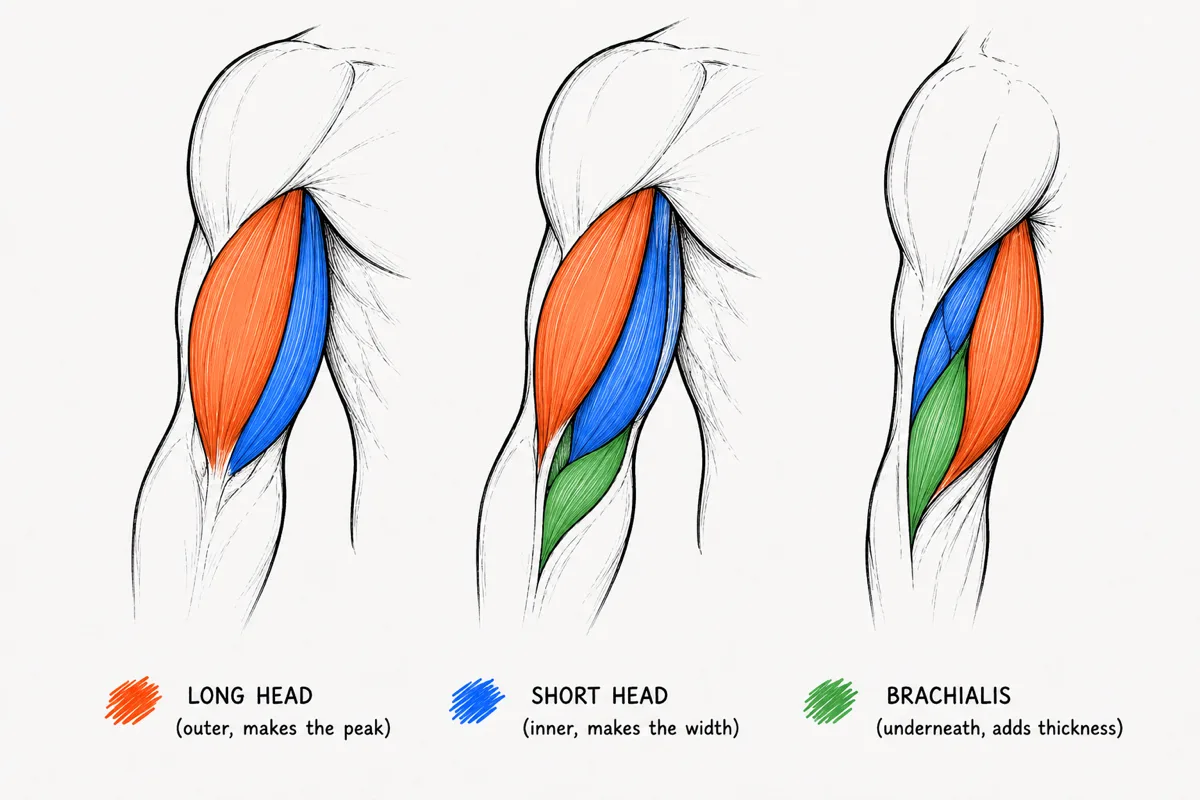
Three exercises, one per part :
- The main curl — EZ-bar, straight bar, or dumbbell curl. Hits both heads; this is your heavy progression lift. EZ-bar is easiest on the wrists.
- Long head (peak) — incline dumbbell curl. Lying back on an incline bench puts the arm behind the body, stretching the long head.
- Short head + a squeeze — preacher curl. The pad removes cheating; the muscle can't hide.
- Brachialis (bonus) — hammer curls (dumbbells, palms facing each other). If you only do three, swap these in for the preacher curl every other week.
Forearms
Two jobs : flexing the wrist (underside) and extending it (top side), plus grip. Honestly, heavy rows, deadlifts and hammer curls already build most of your forearm. If you want direct work :
- Wrist curls (palms up) for the underside.
- Reverse curls or reverse wrist curls (palms down) for the top.
- Farmer's carries — pick up two heavy dumbbells and walk. The simplest grip-and-forearm builder there is.
Legs
Legs are four sections pretending to be one bodypart : quads (front of thigh), hamstrings (back of thigh), glutes, and calves.
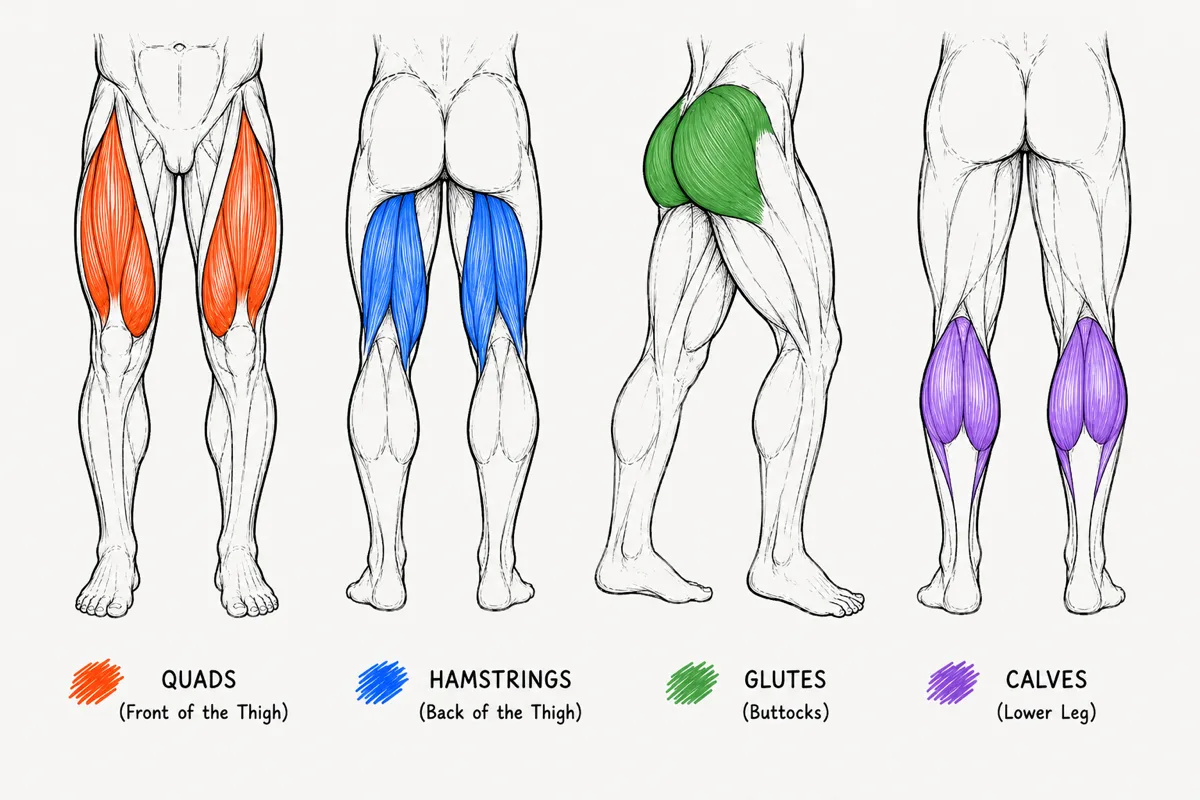
- Quads — squats (barbell, hack squat, or leg press) as the heavy compound, plus leg extensions for isolation. Compound first, isolation after.
- Hamstrings — two motions, do both : a hinge (Romanian deadlift — the stretch under load is unmatched) and a curl (lying or seated leg curl).
- Glutes — squats and Romanian deadlifts already train them hard. Add hip thrusts if glutes are a priority.
- Calves — standing calf raises hit the big visible calf muscle (gastrocnemius); seated calf raises hit the deeper one underneath (soleus). Full stretch at the bottom, pause at the top, no bouncing.
Core
The core's job is flexing your trunk and resisting rotation — and yes, you can train abs 2–3 times a week; they recover fast.
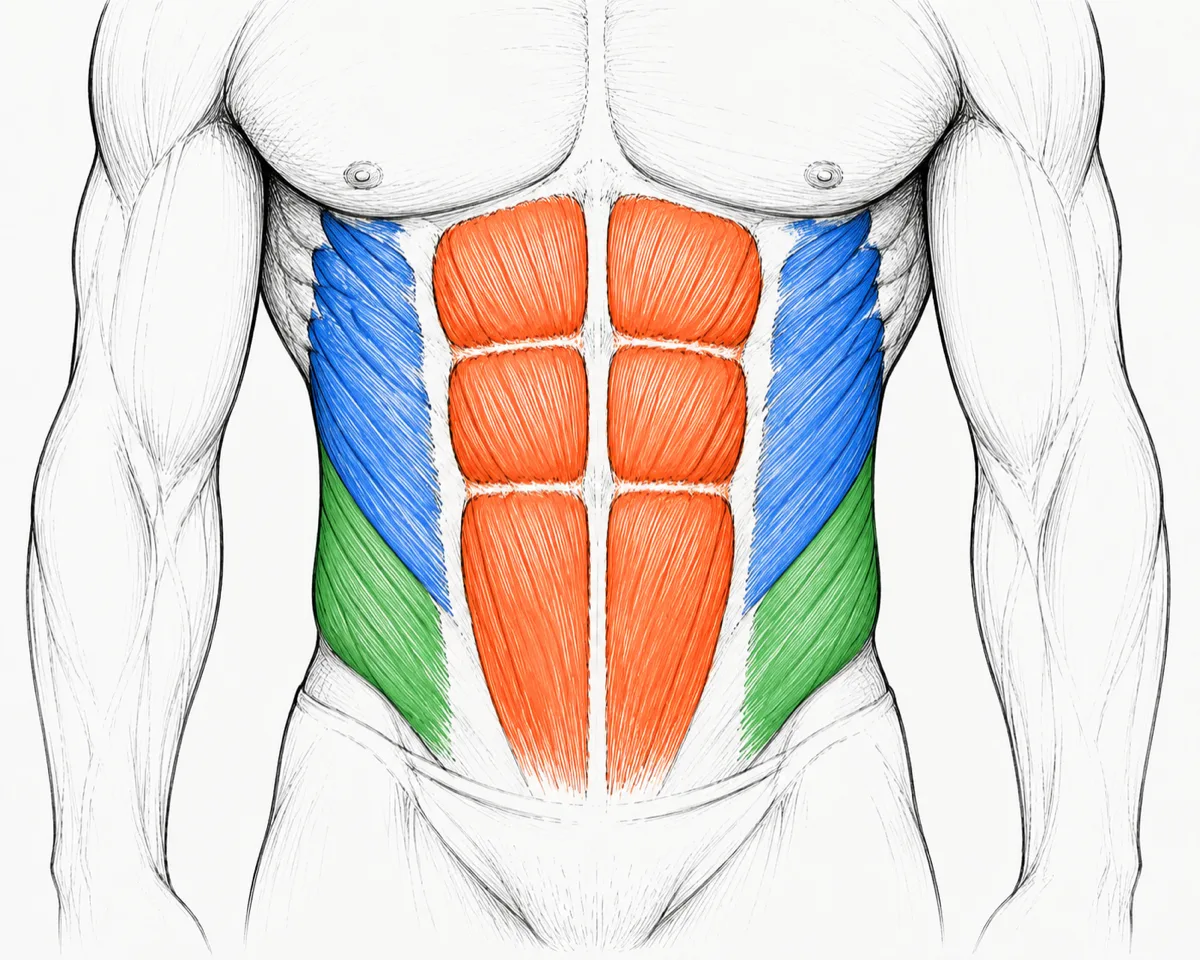
- Abs (with load) — cable crunches. Kneel facing the cable stack, rope behind your head, crunch down. Abs are a muscle like any other : they grow with progressive weight, not with a hundred bodyweight reps.
- Lower abs — hanging leg raises (or lying leg raises to start).
- Stability — planks or ab-wheel rollouts, one or two sets at the end.
And the honest truth : visible abs come from a low enough body-fat percentage, which comes from diet. Training makes them thicker; the kitchen makes them visible.
Putting it together
If you zoom out, the whole gym compresses into about a dozen movement slots :
| Muscle | Slot 1 | Slot 2 |
|---|---|---|
| Chest | Incline press | Flat press + dips/high-to-low fly |
| Shoulders | Overhead press | Cable lateral raise + face pull |
| Triceps | Overhead extension | Pushdown |
| Back | Vertical pull (pulldown/pull-up) | Horizontal pull (row) |
| Traps | Shrugs | — |
| Biceps | EZ-bar curl | Incline or preacher curl |
| Forearms | Hammer curl / farmer's carry | — |
| Legs | Squat + leg extension | RDL + leg curl, calf raises |
| Core | Cable crunch | Leg raise / plank |
Two more things that tie the map together :
Hit each muscle twice a week. A muscle grows for roughly 48–72 hours after you train it — training it once a week leaves half the week wasted. Twice is the sweet spot for most people.
The split I personally follow : Push / Pull / Legs, twice through, with alternating focus. Push day, pull day, legs day, repeat, one rest day. And here's the trick that makes the second pass through actually useful — each repeat shifts the emphasis :
| Day | First pass | Second pass |
|---|---|---|
| Push | Chest-focused (heavy bench first) | Shoulder-focused (overhead press first) |
| Pull | Width-focused (pulldowns, wide rows) | Thickness-focused (T-bar / chest-supported rows) |
| Legs | Quad-focused (squat first) | Hamstring-focused (RDL first) |
Same muscles twice a week, but from different angles and with a different heavy lift leading each session. More complete development, less repetitive strain on the joints, and the workouts never feel like reruns.
If six days is too much, drop to five or run PPL + rest + PPL across eight days — the frequency matters more than the calendar.
Show up consistently, add a little weight or a rep each week, eat your protein — and the process takes care of itself.
That's two years of trial, error, and unlearning, in one page. I wish someone had handed me this on day one.