Every productivity book eventually arrives at the same word : flow.
Get into flow. Protect your flow. Block the calendar, kill the notifications, put the phone in another room. And they're right — I've spent years writing software, and the hours that actually moved things were almost always the uninterrupted ones. Without focus you lose the thread, and losing the thread costs you the afternoon.
So I'm not here to argue with that. Flow is real and it works.
I'm here about the other half, the half nobody puts on a book cover : knowing when to leave.
Your brain has two gears, not one
Back in 2019 I took Learning How to Learn on Coursera — Barbara Oakley's course — and the one idea from it that never left me is this pairing : focused mode and diffuse mode.
Focused mode is the spotlight. Clamped down on one thing, everything else filtered out. It's what flow feels like, and it's excellent at depth.
Diffuse mode is the one that gets no respect. It's what runs when you stop pushing — walking, showering, staring out a window, doing the dishes. And it works completely differently.
Focused mode travels short, well-worn paths very fast. Diffuse mode travels long ones slowly, and it connects things that have no business being connected. Which is exactly why every good idea you've ever had arrived in the shower and not at the desk.
Here's the part that matters : these two modes are mutually exclusive. You cannot be in both. Every minute you spend in the tunnel is a minute the wide-angle lens is switched off.
That's the bill flow quietly hands you, and almost nobody reads it.
The tunnel has a failure mode
You know this feeling even if you've never named it.
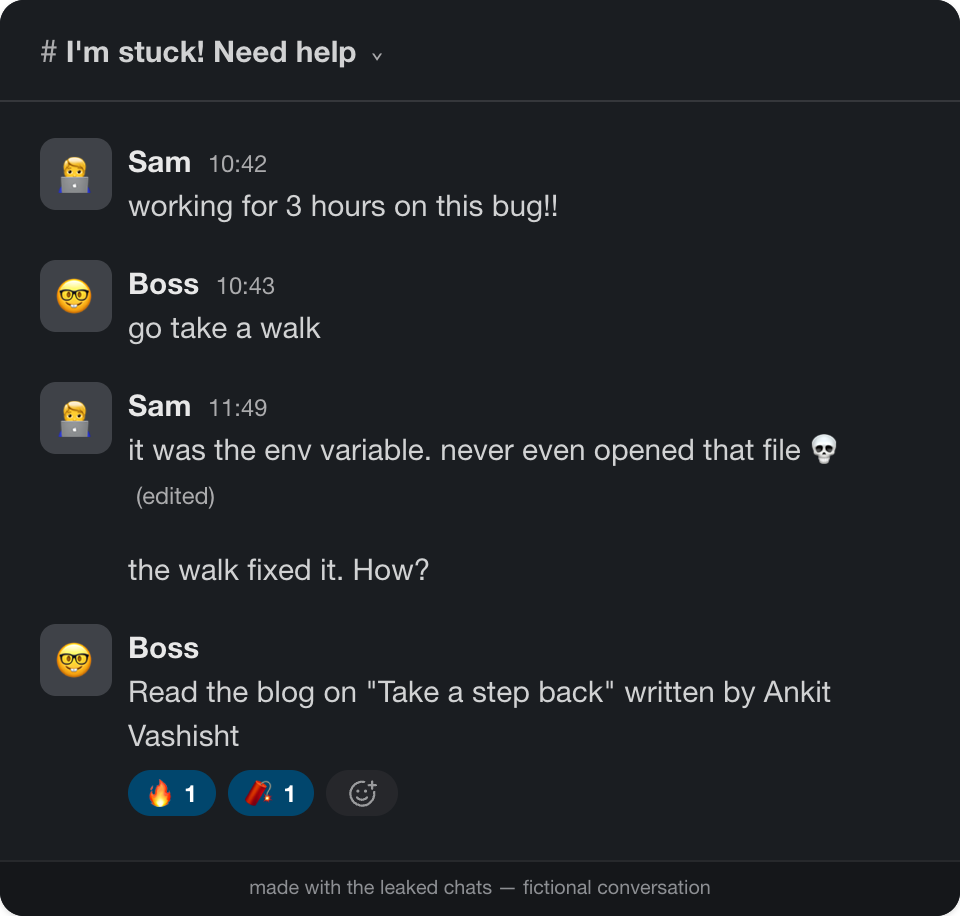
Three hours into a bug. You're deep, you're focused, you're absolutely in flow — and you are getting nowhere. You're re-reading the same forty lines for the ninth time. You add another log statement. You try the same fix with a slightly different shape. The state is all in your head and it's right there, you can feel it, one more pass and you'll have it.
You will not have it. Not on that pass, and not on the next twelve.
Because focus is a commitment device. It commits you to the frame you started with — and if the bug isn't in that frame, no amount of depth will find it. You dig a deeper hole in the wrong field. The tighter the focus, the more confident you feel, and confidence is the last thing you want when your model of the problem is the thing that's broken.
The tell is simple : flow that isn't producing anything is a rabbit hole wearing flow's clothes. Same feeling, opposite result.
What stepping back actually looks like
It isn't quitting. It's changing altitude for a few minutes.
Close the file. Get out of the editor. And then, before you go anywhere near the keyboard again, ask the questions the tunnel doesn't let you ask :
What am I actually trying to achieve? Not the bug — the goal the bug is in the way of. Half the time the thing you're fixing didn't need to exist.
Which piece am I not looking at? You've been staring at the code you suspect. Where are you not looking, and why did you rule it out? Usually that ruling-out happened in the first ten minutes, on almost no evidence, and has been load-bearing ever since.
What if the assumption is wrong? List what you're taking for granted. The bug lives in that list far more often than in the code.
How would someone else see this? A different lens — the data's, the user's, the person who wrote this three years ago. Frames are cheap to swap once you're out of the tunnel and impossible to swap inside it.
Then go for a walk, and let diffuse mode do the part you can't force.
What you find, more often than is comfortable, is that the solution you were grinding towards wasn't a solution at all. It was a patch on a symptom of something one layer up. You'd have shipped it, it would have worked, and it would have been wrong.
The machines figured this out too
Here's what convinced me this isn't just self-help framing — the exact same problem showed up in AI, and the exact same fix worked.
Let a model think in one long unbroken line and it rabbit-holes exactly like we do. Committed to a bad first step, it just reasons very fluently in the wrong direction — depth applied to the wrong frame, all the way to a confident wrong answer.
Two fixes, and both are the thing I'm describing.
The first is the ReAct agentic framework — reason, act, observe, repeat. Instead of thinking straight through, the model is forced to stop, take an action, and look at what came back before continuing. It's a mandatory surfacing. It can't run three hours deep on a bad assumption, because every few steps reality gets a word in.
The second is more on the nose. In 2023 a team at Google DeepMind published a paper on getting models out of exactly this trap — and I promise I had the title of this post before I found it. The paper is called Take a Step Back. The technique : before answering a specific question, make the model first ask itself a more general one. Abstract up, get the governing principle, then come back down and solve the instance. Same problem, more altitude first.
It worked, and not marginally. Double-digit accuracy gains on hard reasoning benchmarks — 27% on one of them — from nothing but a step up in abstraction before diving in.
Which I find quietly funny. We spent years telling ourselves to focus harder. Then we built reasoning machines, watched them fail the way we fail, and the fix that worked was telling them to stop and look around.
So
Flow is not the enemy. Flow is where the work gets done, and you should defend it.
But depth without altitude is just a well-lit hole. The skill isn't focusing harder — most of us can already focus harder than is good for us. The skill is noticing the moment focus stopped paying, and having the discipline to climb out and look at the whole map before going back down.
Get in the tunnel. Do the work. Then leave, on purpose, before the tunnel starts making the decisions.
And on that note — I genuinely won't mind if you stop reading here and go take a step back 🙂
I hope you find this article interesting. Thanks for reading. Until then, bye 👋